

Roulette Split Bets: Guide to Payout, Table & Odds
Roulette includes a variety of bet types, with split bets being one of the options you may come across most often. If you decide to place a bet, having a clear understanding of how split bets work helps you follow the game with accurate information rather than guesswork.
This blog post breaks split bets down step by step. It explains what a split bet is, how it is placed on the table, which numbers it covers, how payouts are calculated, and how the odds differ between European and American roulette.
Read on to learn more.
What Is a Roulette Split Bet?
A split bet in roulette is a wager that involves two numbers positioned next to each other on the table layout. At a basic level, the idea is simple: you are covering more than one number without spreading a stake across a large area of the table.
At first glance, a split may be thought of as sitting between very focused bets and much broader ones. It narrows attention to a small section of the layout while still including more than a single outcome. For players who decide to take part, this may appeal to those looking for a middle ground between coverage and potential payout.
Split bets belong to a group known as inside bets. These are placed directly on the numbered grid rather than on the surrounding areas, such as colours or even and odd. Inside bets vary in size, ranging from single-number wagers to bets that cover several numbers together. A split fits within this range by covering exactly two.
The precise definition of a split bet stays the same across different roulette variants. European and American roulette differ in wheel design, but a split always refers to two adjacent numbers on the layout. Further details about how those differences affect probability appear later.
Understanding the idea behind a split naturally leads to the question of how it is marked on the table.
How Do You Place a Split Bet on a Roulette Table?
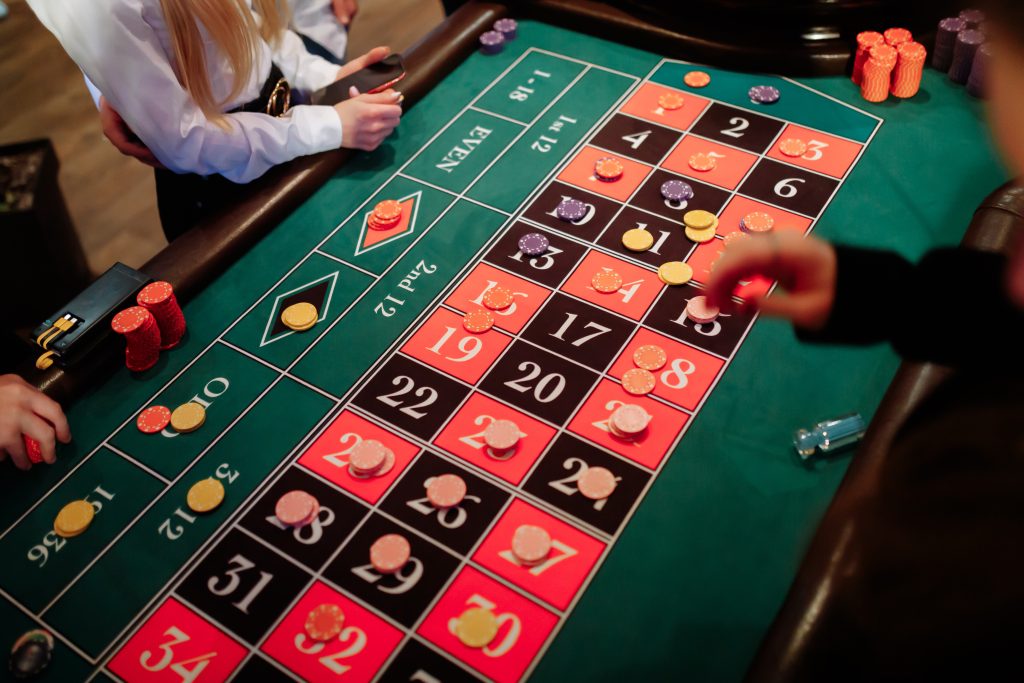
On a standard roulette table, the numbers 1 to 36 are arranged in a grid of three columns and twelve rows. This layout visually shows which numbers sit next to each other, making potential split positions easy to spot.
To place a split, a chip is set directly on the line that separates two neighbouring numbers. The shared line indicates that both numbers are included equally in the wager. This placement applies whether the dividing line runs up and down or from side to side.
Not all touching numbers qualify. Numbers that only meet at a corner do not share a full side, so they do not form a split. A chip placed on a corner represents a different type of wager if the table allows it, rather than a split.
In a land-based casino, chips are placed during the betting window, which opens after the previous spin has been settled. After the dealer closes betting, no further changes are accepted. Online roulette follows the same principle, usually shown by a countdown timer.
Clear placement matters. A chip that is not clearly on the dividing line may be treated as a different bet or rejected. Learning the layout helps ensure that a split bet is recognised as intended.
After placement, it helps to understand exactly which number pairs are eligible.
What Numbers Can Be Covered With a Split Bet?
A split bet may cover any two numbers that share a side on the numbered grid. This includes pairs sitting next to each other across a row, such as 10 and 11, as well as pairs stacked within a column, such as 19 and 22.
Every number from 1 to 36 connects to at least one neighbour, so each has at least one possible split. Numbers located toward the centre of the grid often have several neighbouring options, while numbers on the outer edges naturally have fewer.
Diagonal pairs are excluded. If two numbers only touch at a single point, they are not combined as a split. Dealers and online interfaces generally prevent such placements.
Zero-related splits depend on the table design. Some layouts allow combinations involving zero and certain adjacent numbers, while others restrict these options. These variations are indicated directly on the layout rather than by the general definition of a split.
At this stage, it is worth noting that choosing one valid split over another does not alter the underlying probability on a given wheel. All splits cover two numbers, so their chances remain the same within the same roulette variant. The financial side of that outcome becomes clearer by looking at potential payouts.
What Does a Roulette Split Bet Payout?
A roulette split bet typically pays at odds of 17 to 1 if successful. In practical terms, this means that for each unit staked, seventeen units are won, and the original stake is returned as well. For instance, if you choose to place a £2 split bet and it succeeds, the total amount paid back is £36.
This potential payout sits between other common inside bets. It is lower than the typical 35 to 1 paid for a successful single-number wager and higher than the returns for bets covering larger groups of numbers.
The potential payout figure itself does not change between European and American roulette. Casinos keep the same odds for splits regardless of wheel type. The difference between variants appears elsewhere, rather than in the payout number.
Looking only at the potential payout does not give the full picture. To understand how often a split might succeed, it is necessary to look at how the odds are worked out.
How Are Odds Calculated for Split Bets?
The odds of a split bet are based on how many numbers it covers compared with how many pockets exist on the wheel. A split always includes two numbers, but the total number of pockets varies by roulette version.
European roulette uses 37 pockets: numbers 1 to 36 plus a single zero. A split, therefore, covers 2 out of 37 possible outcomes, which equals roughly 5.41%.
American roulette adds a double zero, increasing the total to 38 pockets. In that case, a split covers 2 out of 38 outcomes, or about 5.26%. The extra pocket slightly reduces the chance of success for all number-based bets.
Although the probability differs, the potential payout remains fixed at 17 to 1. The gap between true probability and potential payout is what produces the casino’s advantage. On a European wheel, this figure is about 2.70% for standard bets. On an American wheel, it rises to roughly 5.26%.
Compared with broader wagers such as red or black, which include 18 numbers, a split will succeed less often. The trade-off is a higher return relative to the stake on the occasions it does succeed. Understanding this balance may help explain how different bets behave over repeated play.
These mathematical differences also explain why the same split may feel different depending on the roulette variant.
Are Split Bets Different on European and American Roulette?
In practical terms, split bets are placed in the same way on both European and American tables. If you are playing either version, you select two neighbouring numbers and place a chip on the line that divides them. The layout markings and dealer recognition are consistent.
The distinction comes from the wheel design. European roulette has one zero, while American roulette includes both a zero and a double zero. This additional pocket reduces the probability of winning any inside bet, including splits.
Although the potential payout stays the same, the overall expectation differs because of this added pocket. This applies to all standard wagers rather than to splits alone.
Each spin of the wheel is independent of previous results. Past outcomes do not influence future ones, regardless of the bet type chosen. Learning how split bets work, what they cover, and how their odds are calculated provides factual context only.
If you choose to play roulette or any other casino game, it is important to gamble responsibly, set spending limits, and step away if the activity stops being entertaining.
Play Roulette Online at Rose Casino
At Rose Casino, we give you clear information so you can decide whether our roulette tables are right for you. We’re licensed and regulated by the UK Gambling Commission (UKGC), and our site includes practical tools such as deposit limits, time reminders and the option to take a break if you choose to pause your play.
You’ll find a choice of live dealer roulette, streamed in real time, alongside computer-based RNG tables that are available around the clock. We offer both classic versions of the game and more modern variations, allowing you to explore different formats and decide which ones appeal to you.
If this suits what you’re looking for, you can create an account at Rose Casino, deposit some funds to play with and explore our roulette tables at your own pace.
**The information provided in this blog is intended for educational purposes and should not be construed as betting advice or a guarantee of success. Always gamble responsibly.