

Understanding Aces in Blackjack: 2 Aces Explained Clearly
Aces are the most flexible cards in blackjack, and starting with two can create a situation that may seem unusual at first. This guide explains how aces are valued, how two aces can interact in a hand, and the decisions a player might make under typical UK casino rules.
You will also learn the difference between soft and hard hands, how splitting works, and the limitations that can apply. By understanding these points, you may follow the game more confidently and understand why two aces are treated differently from other pairs.
What’s The Ace’s Value In Blackjack?
In blackjack, an ace can be worth 1 or 11, depending on which value may help keep the total hand at 21 or below. For example, if your hand contains an ace and a 7, the total can be counted as 8 or 18. The game automatically uses the value that keeps the hand playable. If drawing a new card would take the total over 21, the ace is counted as 1.
A hand that includes an ace counted as 11 is called a soft hand, because the total can adjust if needed. If all aces in a hand are counted as 1, or if there are no aces at all, the hand is a hard hand.
Blackjack rules can differ between tables and game variants, so it can be helpful to review the paytable or rules for the specific game before playing.
How Do Two Aces Work In A Single Hand?
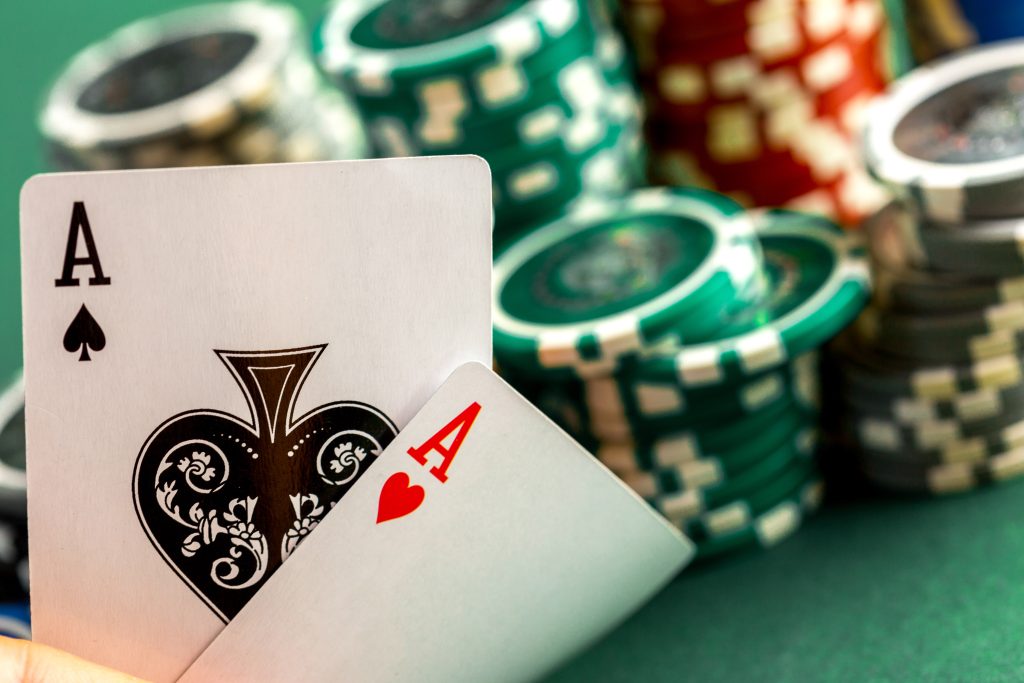
If you are dealt two aces, their combined value is not 22. Instead, one ace counts as 11 and the other as 1, giving a total of 12. This creates a soft 12 because one ace can still be treated as 11 if the total allows.
Most UK blackjack games allow you to split the aces:
- Each ace becomes the first card of a new hand.
- A second bet equal to the original stake is placed.
- Each hand receives one additional card.
Rules often include limitations after splitting aces. For example, some tables may permit only one additional card per split ace and do not allow re-splitting if another ace is drawn. A hand that reaches 21 after splitting is generally counted as a regular 21, not a natural blackjack.
Why Do Players Split Two Aces?
Splitting two aces turns one soft 12 into two separate hands, each beginning with an ace. This gives each hand the potential to reach higher totals. If either ace receives a 10-point card (10, Jack, Queen, King), that hand totals 21.
In a single-deck game, after two aces are dealt, 16 of the remaining 50 cards are worth 10. This means that roughly one in three draws could produce a 21 on that hand. Even without a 10-point card, drawing a 9 or 8 produces strong totals of 20 or 19, which can be competitive against the dealer.
The options and outcomes after splitting are influenced by table rules, including how many cards are allowed and whether further splits are possible.
Is Getting Two Aces Good Or Bad In Blackjack?
Being dealt two aces is uncommon. In a single-deck game, it happens in roughly 0.45% of hands. Whether this leads to a favourable or difficult position depends on the cards that follow and the rules in place, rather than the aces alone.
If splitting is not allowed, the hand begins as a soft 12, which offers limited options. When splitting is permitted, the aces form two separate hands, each starting with an ace. The final totals then depend entirely on which cards are dealt next.
Table rules, such as limits on additional cards or re-splitting, shape how the hand can develop. The dealer’s upcard, the number of decks used, and the specific game rules also play a part in how the round may unfold.
Play Blackjack Online At Rose Casino
Play blackjack online at Rose Casino, licensed and regulated by the UK Gambling Commission (UKGC). You’ll find a broad selection of games, from classic blackjack to live dealer tables and a wide range of slots.
Log in or join Rose Casino to explore the full library and see which tables might suit how you like to play. Set limits that work for you, and only play with what you can afford.
*All values (Bet Levels, Maximum Wins etc.) mentioned in relation to these games are subject to change at any time. Game features mentioned may not be available in some jurisdictions.
**The information provided in this blog is intended for educational purposes and should not be construed as betting advice or a guarantee of success. Always gamble responsibly.